Best Cloud Security Platforms for Small Businesses
As small businesses increasingly embrace digital transformation, cloud computing has become an essential part of daily operations. From storing sensitive customer information to managing remote teams and running business applications, the cloud offers flexibility and affordability that traditional IT infrastructure often cannot match. However, the growing dependence on cloud technology also exposes small businesses to cyber threats that were once considered concerns only for large enterprises.
Cybercriminals frequently target smaller organizations because they often have limited security resources, smaller IT teams, and less sophisticated defenses. Data breaches, ransomware attacks, phishing campaigns, and unauthorized access can result in financial losses, legal liabilities, and damage to customer trust.
Fortunately, modern cloud security platforms have evolved to address these challenges. Many providers now offer enterprise-grade protection tailored specifically to the needs and budgets of small businesses. Choosing the right solution can significantly reduce risks while allowing organizations to focus on growth and innovation.
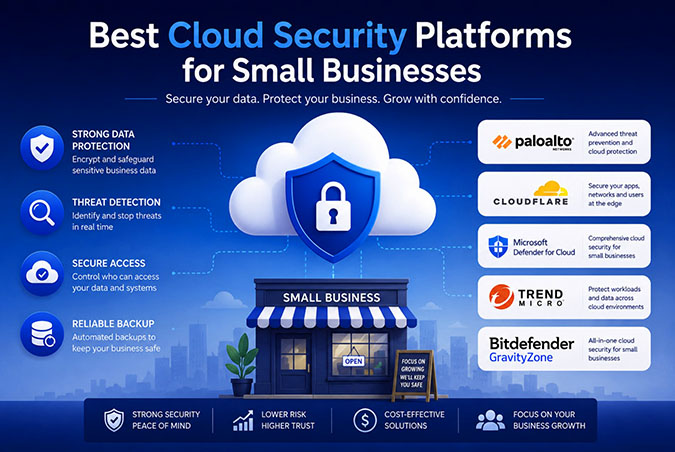
Why Cloud Security Matters for Small Businesses
Many small business owners mistakenly assume they are too small to become targets of cyberattacks. In reality, attackers often view smaller companies as easier entry points due to weaker defenses.
Cloud security platforms help businesses protect their digital assets by offering features such as:
- Threat detection and prevention
- Identity and access management
- Data encryption
- Compliance monitoring
- Secure backup and recovery
- Vulnerability assessments
- Multi-factor authentication
- Security analytics and reporting
Implementing these tools creates multiple layers of protection that reduce the likelihood and impact of security incidents.
Key Features to Look For
Before selecting a cloud security platform, small businesses should evaluate several important factors.
Ease of Deployment
Most small companies lack dedicated cybersecurity specialists. Solutions with intuitive dashboards, automated configurations, and straightforward deployment processes minimize administrative burdens.
Scalability
A platform should accommodate future growth. As businesses expand their workforce, applications, and customer base, security capabilities must scale accordingly.
Compliance Support
Organizations operating in regulated industries may need assistance complying with standards such as GDPR, HIPAA, PCI DSS, or other data privacy requirements.
Centralized Visibility
Managing security through a single console simplifies monitoring and incident response while reducing operational complexity.
Cost Efficiency
Budget constraints are common among small businesses. Subscription-based pricing and flexible licensing models help organizations access robust protection without major capital investments.
1. Microsoft Defender for Cloud
Microsoft Defender for Cloud has become one of the most comprehensive security platforms available, particularly for businesses already using Microsoft services.
The solution provides continuous assessment of cloud environments, identifies vulnerabilities, and recommends remediation steps. Its integrated approach enables organizations to secure workloads running across hybrid and multi-cloud environments.
Key benefits include:
- Built-in threat detection
- Security posture management
- Regulatory compliance tracking
- Integration with Microsoft 365 and Azure
- Automated recommendations
Small businesses familiar with Microsoft’s ecosystem often find the learning curve relatively manageable.
2. CrowdStrike Falcon Cloud Security
CrowdStrike has earned a strong reputation for endpoint protection and threat intelligence. Falcon Cloud Security extends these capabilities into cloud environments.
The platform leverages artificial intelligence and behavioral analytics to identify suspicious activity before threats escalate into major incidents.
Advantages include:
- Real-time threat monitoring
- Agent-based and agentless protection
- Automated response capabilities
- Cloud workload protection
- Advanced threat intelligence
Its modern interface and proactive detection capabilities make it attractive to organizations seeking robust protection without maintaining extensive internal security teams.
3. Palo Alto Networks Prisma Cloud
Prisma Cloud offers end-to-end visibility across cloud infrastructures, applications, and data.
Designed to secure development pipelines as well as production environments, it enables businesses to identify vulnerabilities early in the software lifecycle.
Notable features include:
- Cloud security posture management
- Container security
- Infrastructure-as-code scanning
- Compliance reporting
- Runtime protection
Although often associated with larger enterprises, Prisma Cloud offers capabilities that growing small businesses can benefit from as their environments become more complex.
4. Trend Micro Cloud One
Trend Micro has decades of cybersecurity experience and provides a flexible cloud security solution through Cloud One.
The platform consists of multiple services that businesses can adopt according to their needs, preventing unnecessary expenses.
Core capabilities include:
- Workload security
- File storage protection
- Application security
- Network security
- Container protection
Its modular structure allows small organizations to prioritize investments based on immediate security concerns while maintaining room for expansion.
5. Check Point CloudGuard
CloudGuard focuses on preventing misconfigurations and securing cloud infrastructures against evolving threats.
Configuration errors remain among the leading causes of cloud-related data breaches. CloudGuard continuously analyzes environments to identify risks before attackers exploit them.
Benefits include:
- Automated compliance checks
- Threat prevention
- Security posture management
- Multi-cloud visibility
- Risk prioritization
Businesses operating across several cloud providers may particularly appreciate its unified approach.
6. Zscaler Zero Trust Exchange
Remote work has fundamentally changed the way businesses operate. Traditional network perimeters no longer provide sufficient protection.
Zscaler embraces a zero-trust model based on the principle of “never trust, always verify.” Every user, device, and application request is continuously evaluated before access is granted.
Key strengths include:
- Secure internet access
- Zero-trust network access
- Data loss prevention
- Cloud firewall capabilities
- User experience optimization
For organizations with distributed teams, Zscaler can improve both security and connectivity.
7. Sophos Intercept X for Server
Sophos is widely recognized among small and medium-sized businesses for offering effective yet manageable cybersecurity solutions.
Intercept X for Server extends protection into cloud workloads using machine learning and anti-ransomware technologies.
Features include:
- Exploit prevention
- Behavioral analysis
- Anti-ransomware protection
- Root cause investigation
- Centralized administration
Its user-friendly interface appeals to businesses with limited technical expertise.
How to Choose the Right Platform
Selecting the ideal cloud security platform depends largely on organizational needs.
Businesses should begin by identifying their most valuable digital assets and understanding potential risks. Questions to consider include:
- Which cloud services are currently in use?
- How sensitive is the stored data?
- Are there regulatory requirements to satisfy?
- What is the available security budget?
- Who will manage the solution internally?
Testing products through free trials or demonstrations can provide valuable insights into usability and effectiveness.
Decision-makers should also assess vendor reputation, customer support quality, and update frequency. Security is not a one-time investment but an ongoing commitment that requires dependable partnerships.
Best Practices Beyond Technology
Even the most advanced platform cannot guarantee complete protection if basic security practices are neglected.
Small businesses should complement their cloud security investments with the following measures:
Employee Training
Human error remains a significant factor in cybersecurity incidents. Staff should receive regular education about phishing attempts, password hygiene, and safe browsing habits.
Multi-Factor Authentication
Requiring additional verification methods significantly reduces the risk of unauthorized access.
Regular Backups
Maintaining secure backups ensures critical information can be restored following ransomware attacks or accidental deletion.
Least Privilege Access
Employees should only have access to the resources necessary to perform their responsibilities.
Incident Response Planning
Organizations should establish clear procedures outlining how to respond when security incidents occur.
The Future of Cloud Security
As cyber threats continue evolving, cloud security platforms are increasingly incorporating automation, artificial intelligence, and predictive analytics.
Future innovations will likely focus on identifying threats before they materialize, simplifying compliance management, and enhancing visibility across increasingly complex digital ecosystems.
Small businesses that proactively invest in modern security solutions position themselves not only to reduce risk but also to build trust with customers, partners, and stakeholders.
Conclusion
Cloud adoption presents tremendous opportunities for small businesses, enabling greater efficiency, collaboration, and competitiveness. However, these benefits come with responsibilities. Protecting sensitive data and maintaining operational resilience must remain top priorities.
Platforms such as Microsoft Defender for Cloud, CrowdStrike Falcon, Prisma Cloud, Trend Micro Cloud One, Check Point CloudGuard, Zscaler, and Sophos provide powerful tools tailored to a variety of business needs and budgets.
By carefully evaluating requirements, implementing appropriate technologies, and fostering a culture of cybersecurity awareness, small businesses can confidently navigate the cloud era while minimizing exposure to digital threats. In an increasingly connected world, investing in cloud security is no longer optional—it is a fundamental component of sustainable business success.