How AI-Powered Cloud Computing Is Transforming Modern Businesses
Introduction
The digital revolution has entered a new era where artificial intelligence (AI) and cloud computing work together to redefine how organizations operate. Individually, these technologies have already reshaped industries. However, when combined, AI-powered cloud computing creates an intelligent, scalable, and highly efficient environment that enables businesses to innovate faster than ever before.
From startups to multinational corporations, organizations are adopting AI-driven cloud solutions to automate repetitive tasks, improve customer experiences, enhance cybersecurity, and make data-driven decisions in real time. As competition grows increasingly fierce, businesses that embrace this technological combination gain a significant advantage over those relying on traditional IT infrastructure.
This article explores how AI-powered cloud computing is transforming modern businesses, its key benefits, practical applications, challenges, and future trends.
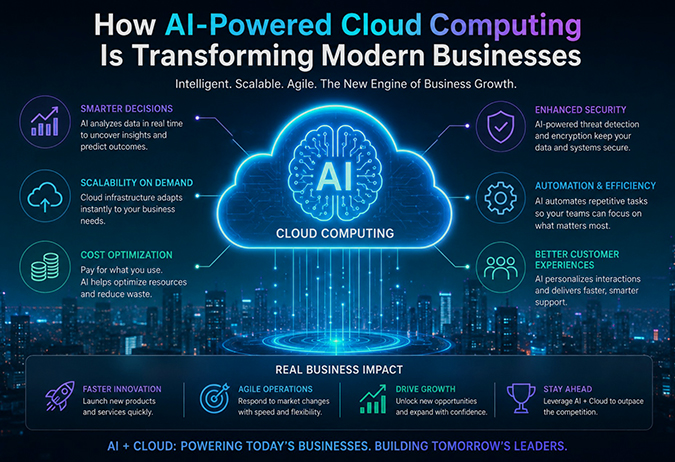
What Is AI-Powered Cloud Computing?
AI-powered cloud computing refers to cloud platforms that integrate artificial intelligence technologies such as machine learning, natural language processing, computer vision, predictive analytics, and automation into cloud services.
Instead of merely storing data or hosting applications, modern cloud platforms actively analyze information, recognize patterns, predict outcomes, and automate decision-making processes.
This intelligent infrastructure allows organizations to access advanced AI capabilities without investing heavily in expensive hardware or maintaining complex data centers.
Why Businesses Are Embracing AI in the Cloud
Several factors are driving rapid adoption across industries.
1. Scalability Without Limits
Traditional IT infrastructure often requires businesses to purchase additional servers whenever demand increases. Cloud computing eliminates this problem by allowing companies to scale computing resources instantly.
When AI is added, businesses can automatically optimize resource allocation based on user demand, reducing waste while maintaining excellent performance.
2. Lower Operational Costs
Maintaining on-premises infrastructure is expensive. Companies must invest in servers, networking equipment, electricity, cooling systems, and IT personnel.
AI-powered cloud services reduce these expenses by automating maintenance, monitoring system health, detecting inefficiencies, and optimizing workloads.
Organizations pay only for the resources they actually use.
3. Faster Innovation
Developers can quickly build, train, and deploy AI models using cloud platforms without purchasing specialized hardware.
This dramatically shortens product development cycles, enabling businesses to launch innovative services much faster.
Intelligent Data Analysis
Modern businesses generate enormous volumes of data every day.
Customer interactions, website traffic, sales transactions, inventory updates, financial records, and social media activity all contribute to a growing mountain of information.
Without AI, much of this data remains underutilized.
AI-powered cloud computing transforms raw data into actionable insights by:
- Identifying hidden trends
- Predicting customer behavior
- Detecting anomalies
- Forecasting sales
- Improving operational efficiency
- Recommending business strategies
Decision-makers no longer rely solely on historical reports. Instead, they receive real-time recommendations generated through advanced analytics.
Improving Customer Experience
Customer expectations continue to rise.
People expect personalized recommendations, instant support, and seamless digital experiences.
AI-powered cloud platforms help businesses meet these expectations through intelligent customer engagement.
AI Chatbots
Cloud-based AI assistants provide 24/7 customer service by answering common questions, processing requests, and solving basic problems without human intervention.
This reduces waiting times while lowering support costs.
Personalized Recommendations
Streaming platforms, online retailers, and digital marketplaces analyze customer preferences using AI.
Cloud infrastructure processes millions of interactions to recommend products, movies, music, or services tailored to each individual.
This personalization significantly increases customer satisfaction and sales conversions.
Sentiment Analysis
AI examines customer reviews, emails, and social media conversations to determine public opinion about products or services.
Businesses can respond quickly to complaints and improve their offerings based on customer feedback.
Enhancing Business Automation
Automation is one of the greatest advantages of AI-powered cloud computing.
Routine tasks that once consumed hours can now be completed automatically.
Examples include:
- Invoice processing
- Payroll management
- Data entry
- Email classification
- Inventory monitoring
- Appointment scheduling
- Fraud detection
Employees spend less time performing repetitive work and more time focusing on creativity, strategy, and innovation.
Strengthening Cybersecurity
Cyber threats continue to evolve.
Hackers use increasingly sophisticated techniques to exploit vulnerabilities.
Fortunately, AI has become one of the strongest defenses against cybercrime.
Cloud providers employ AI systems capable of monitoring billions of security events every day.
These systems can:
- Detect unusual login behavior
- Identify malware patterns
- Recognize phishing attacks
- Block suspicious network activity
- Predict potential security risks
Instead of waiting for attacks to occur, AI enables proactive cybersecurity measures.
Revolutionizing Healthcare
Healthcare organizations increasingly rely on AI-powered cloud platforms.
Medical professionals use cloud AI to:
- Analyze medical images
- Predict disease risks
- Assist diagnoses
- Monitor patients remotely
- Organize electronic health records
Doctors gain faster access to patient information while improving diagnostic accuracy.
Researchers also benefit from cloud computing by processing massive medical datasets that would otherwise require enormous computing resources.
Transforming Financial Services
Banks and financial institutions generate vast amounts of transactional data.
AI-powered cloud computing helps them:
- Detect fraudulent transactions
- Evaluate loan applications
- Assess financial risks
- Automate customer service
- Monitor regulatory compliance
Machine learning algorithms continuously improve by learning from new data, making fraud detection increasingly accurate over time.
Optimizing Supply Chain Management
Global supply chains have become more complex than ever.
AI-powered cloud platforms provide complete visibility across logistics networks.
Businesses can:
- Forecast product demand
- Optimize delivery routes
- Reduce inventory shortages
- Improve warehouse management
- Monitor supplier performance
Predictive analytics helps organizations respond quickly to disruptions such as weather events, transportation delays, or sudden market changes.
Supporting Remote Work
The rise of remote and hybrid work has accelerated cloud adoption.
Employees now collaborate from virtually anywhere using cloud-based applications.
AI enhances remote work by offering:
- Automatic meeting transcription
- Language translation
- Smart scheduling
- Document summarization
- Intelligent search
- Virtual assistants
These capabilities improve productivity while simplifying collaboration across global teams.
Accelerating Software Development
Software development has changed dramatically thanks to AI-powered cloud services.
Developers use AI to:
- Generate code suggestions
- Detect software bugs
- Perform automated testing
- Optimize application performance
- Monitor cloud infrastructure
Development teams spend less time debugging and more time building innovative features.
Continuous integration and continuous deployment pipelines become faster and more reliable.
Challenges Businesses Must Consider
Despite its many advantages, AI-powered cloud computing also presents several challenges.
Data Privacy
Organizations must ensure customer data remains secure and complies with privacy regulations.
Proper encryption, access controls, and governance policies are essential.
AI Bias
Machine learning models learn from historical data.
If the training data contains bias, AI systems may produce unfair or inaccurate outcomes.
Regular auditing and responsible AI practices help minimize this risk.
Integration Complexity
Many businesses still operate legacy systems.
Integrating modern AI cloud solutions with older infrastructure may require significant planning and investment.
Skills Gap
Organizations need employees with expertise in cloud architecture, machine learning, cybersecurity, and data science.
Training existing staff and hiring qualified professionals remain important priorities.
Future Trends
AI-powered cloud computing continues evolving rapidly.
Several emerging trends are expected to shape the future.
Generative AI
Businesses increasingly use generative AI to create documents, marketing content, software code, product designs, and customer support responses.
Cloud platforms provide the computing power necessary to run these advanced models efficiently.
Edge AI
Instead of sending all data to centralized cloud servers, AI processes information closer to devices at the network edge.
This reduces latency and improves performance for applications such as autonomous vehicles, manufacturing equipment, and smart cities.
Autonomous Cloud Management
Future cloud platforms will increasingly manage themselves.
AI systems will automatically allocate resources, repair failures, optimize costs, and strengthen security with minimal human intervention.
Sustainable Computing
AI helps reduce energy consumption by optimizing data center operations, improving cooling efficiency, and managing workloads more intelligently.
This supports both environmental sustainability and cost reduction.
Conclusion
AI-powered cloud computing is no longer a futuristic concept—it has become a core driver of digital transformation. By combining the scalability of cloud infrastructure with the intelligence of artificial intelligence, businesses can automate operations, analyze vast amounts of data, enhance cybersecurity, improve customer experiences, and accelerate innovation.
Organizations across healthcare, finance, retail, manufacturing, logistics, and countless other industries are already realizing the benefits of intelligent cloud solutions. While challenges such as data privacy, system integration, and AI governance require careful attention, the long-term advantages far outweigh the obstacles.
As AI technologies continue to advance and cloud platforms become even more intelligent, businesses that invest in AI-powered cloud computing today will be better positioned to compete, adapt, and thrive in tomorrow’s rapidly evolving digital economy.