Best Multi-Cloud Management Tools for Enterprise IT Teams
Modern enterprises rarely rely on a single cloud provider. Instead, organizations distribute workloads across multiple cloud platforms to improve flexibility, increase resilience, optimize costs, and avoid vendor lock-in. While this multi-cloud strategy offers significant advantages, it also introduces new challenges related to visibility, governance, security, compliance, and operational complexity.
To address these challenges, enterprise IT teams depend on specialized multi-cloud management tools that provide centralized control over diverse cloud environments. These platforms simplify administration while helping businesses maintain performance, security, and cost efficiency across public, private, and hybrid clouds.
This article explores the best multi-cloud management tools available today, their essential features, and how enterprise organizations can choose the right platform for long-term success.
What Is Multi-Cloud Management?
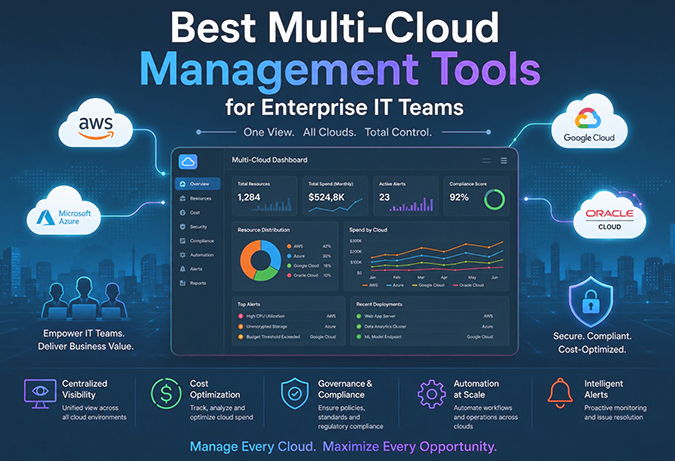
Multi-cloud management refers to the process of monitoring, governing, automating, and optimizing workloads running across multiple cloud service providers. Instead of managing each cloud independently, organizations use centralized platforms to control resources from a single dashboard.
A typical enterprise environment may include:
- Amazon Web Services (AWS)
- Microsoft Azure
- Google Cloud Platform (GCP)
- Private cloud infrastructure
- VMware environments
- Kubernetes clusters
- Edge computing resources
Managing these environments manually quickly becomes inefficient as cloud adoption grows.
Why Enterprise IT Teams Need Multi-Cloud Management Tools
As businesses scale globally, cloud infrastructures become increasingly complex. Different departments may deploy applications on different cloud providers based on pricing, performance, compliance requirements, or regional availability.
Without centralized management, organizations often experience:
- Resource sprawl
- Duplicate infrastructure
- Inconsistent security policies
- Rising cloud costs
- Compliance gaps
- Operational inefficiencies
- Slow incident response
Multi-cloud management platforms solve these issues by providing unified governance and automation.
Key Features to Look For
The best enterprise solutions typically include the following capabilities.
1. Unified Cloud Visibility
A centralized dashboard allows administrators to monitor every cloud account, virtual machine, database, storage service, and container from one interface.
Complete visibility reduces blind spots and improves decision-making.
2. Cost Optimization
Cloud spending can quickly exceed budgets without continuous monitoring.
Advanced platforms help organizations:
- Detect idle resources
- Recommend right-sizing
- Identify unused storage
- Monitor reserved instances
- Track spending trends
- Forecast future costs
Cloud cost optimization has become one of the primary reasons companies invest in management platforms.
3. Security Monitoring
Security remains a major concern for enterprises operating across multiple providers.
Leading solutions include:
- Continuous vulnerability scanning
- Identity management
- Policy enforcement
- Encryption monitoring
- Threat detection
- Compliance auditing
Centralized security policies reduce configuration errors.
4. Automation
Automation significantly reduces operational workloads.
Examples include:
- Automated provisioning
- Infrastructure as Code (IaC)
- Auto scaling
- Scheduled backups
- Patch management
- Resource tagging
- Incident remediation
Automation enables IT teams to focus on innovation rather than repetitive administrative tasks.
5. Compliance Management
Industries such as finance, healthcare, and government must comply with strict regulations.
Modern platforms assist with:
- GDPR
- HIPAA
- PCI DSS
- ISO 27001
- SOC 2
- NIST
Continuous compliance monitoring minimizes audit preparation time.
Best Multi-Cloud Management Tools
Below are some of the leading platforms trusted by enterprise IT teams.
VMware Aria
Formerly known as VMware vRealize Suite, VMware Aria provides extensive cloud management capabilities for hybrid and multi-cloud environments.
Strengths include:
- Infrastructure automation
- Cost analytics
- Capacity planning
- Governance
- Performance monitoring
- Self-service provisioning
Organizations already invested in VMware virtualization benefit greatly from its integration capabilities.
Flexera One
Flexera specializes in cloud financial management and IT asset optimization.
Its platform helps enterprises:
- Analyze cloud spending
- Optimize licenses
- Track SaaS usage
- Govern cloud resources
- Improve budgeting
It is particularly valuable for FinOps teams seeking greater financial visibility.
Morpheus Data
Morpheus Data offers a highly flexible cloud management platform supporting hundreds of technologies.
Key capabilities include:
- Self-service provisioning
- Hybrid cloud automation
- Role-based access
- Cost analytics
- Kubernetes management
- Workflow automation
It supports nearly every major infrastructure provider.
CloudBolt
CloudBolt focuses on simplifying hybrid cloud management while improving operational efficiency.
Features include:
- Resource orchestration
- Governance
- Cost control
- Automation
- Policy management
- Infrastructure provisioning
Its low-code automation capabilities reduce deployment complexity.
Nutanix Cloud Manager
Nutanix Cloud Manager combines private cloud simplicity with public cloud flexibility.
Advantages include:
- Intelligent automation
- Capacity optimization
- Security compliance
- AI-powered recommendations
- Cost optimization
- Unified operations
It performs particularly well for organizations operating hyperconverged infrastructure.
IBM Turbonomic
IBM Turbonomic uses AI to optimize application performance continuously.
Key strengths include:
- Automated resource allocation
- Performance optimization
- Cost reduction
- Capacity forecasting
- Kubernetes optimization
- Application dependency analysis
Its AI engine helps maintain application performance while reducing infrastructure expenses.
BMC Helix Cloud Management
BMC provides enterprise-grade cloud governance and automation.
Core capabilities include:
- Multi-cloud orchestration
- Service catalogs
- Compliance enforcement
- Cost governance
- ITSM integration
- Workflow automation
Large enterprises appreciate its mature IT service management ecosystem.
Red Hat OpenShift
Although primarily known as a Kubernetes platform, OpenShift also serves as an effective multi-cloud management solution.
Benefits include:
- Container orchestration
- Hybrid cloud deployment
- CI/CD integration
- Security controls
- DevOps automation
- Application portability
It is ideal for cloud-native application development.
Benefits of Multi-Cloud Management Platforms
Improved Operational Efficiency
Instead of switching between numerous cloud consoles, administrators manage everything from one location.
This reduces complexity while improving productivity.
Better Cost Control
Cloud optimization tools identify waste automatically, helping organizations reduce unnecessary spending.
Many enterprises save millions annually by eliminating underutilized resources.
Stronger Security
Consistent security policies across all cloud providers significantly reduce vulnerabilities caused by human error.
Centralized monitoring also improves incident response.
Enhanced Compliance
Continuous compliance checks simplify audits while reducing regulatory risk.
Automated reporting also saves valuable staff time.
Increased Business Agility
Automation allows IT teams to deploy infrastructure within minutes rather than days.
Rapid deployment accelerates digital transformation initiatives.
Despite their advantages, these platforms require careful implementation.
Common challenges include:
Learning Curve
Enterprise management platforms often include hundreds of features requiring specialized training.
Integration Complexity
Legacy systems may require custom integrations before full automation becomes possible.
Data Governance
Organizations must establish consistent policies for:
- Data classification
- Backup
- Retention
- Encryption
- Access control
Without governance, operational complexity remains high.
Cost of Adoption
Enterprise licensing can represent a significant investment.
However, long-term savings from optimized cloud spending often outweigh initial costs.
Best Practices for Successful Multi-Cloud Management
Enterprise IT teams should follow several best practices.
Standardize Resource Tagging
Consistent tagging improves:
- Cost reporting
- Automation
- Governance
- Inventory management
Implement Least Privilege Access
Grant users only the permissions necessary to perform their responsibilities.
This reduces insider risk.
Automate Wherever Possible
Routine administrative tasks should be automated whenever practical.
Examples include:
- Backups
- Scaling
- Patch deployment
- Compliance checks
- Monitoring
Automation reduces human error.
Continuously Monitor Costs
Cloud pricing changes frequently.
Regular monitoring ensures organizations remain within budget while identifying optimization opportunities.
Use Infrastructure as Code
Infrastructure as Code ensures consistent deployments across every cloud provider.
It also simplifies disaster recovery and environment replication.
Future Trends in Multi-Cloud Management
The next generation of enterprise cloud management platforms will become increasingly intelligent.
Emerging innovations include:
- AI-driven infrastructure optimization
- Predictive cloud cost forecasting
- Autonomous remediation
- Intelligent workload placement
- Advanced Kubernetes governance
- Zero Trust security integration
- Real-time sustainability reporting
- Green cloud optimization
Artificial intelligence will increasingly automate resource allocation while reducing operational overhead.
Meanwhile, FinOps practices will become standard across enterprise cloud operations, encouraging closer collaboration between finance and IT departments.
Edge computing will also expand the scope of multi-cloud management, requiring platforms to manage distributed infrastructure alongside traditional public and private clouds.
Conclusion
As enterprise cloud environments continue to grow in complexity, effective multi-cloud management has become essential rather than optional. Centralized management platforms enable organizations to streamline operations, strengthen security, enforce compliance, and optimize cloud spending across multiple providers.
Whether an enterprise prioritizes automation, financial governance, Kubernetes orchestration, or AI-driven optimization, there is a multi-cloud management solution designed to meet those needs. By carefully evaluating platform capabilities, integration options, scalability, and long-term support, IT leaders can build a resilient cloud strategy that supports innovation while maintaining control.
Investing in the right multi-cloud management tool not only simplifies day-to-day administration but also positions enterprise IT teams to adapt quickly to evolving technologies, changing business demands, and future digital transformation initiatives.