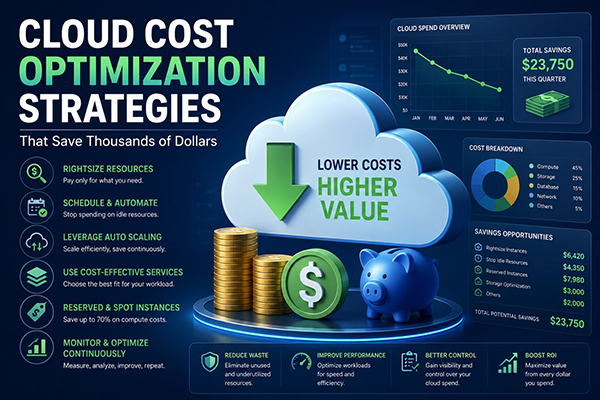
Cloud Cost Optimization Strategies That Save Thousands of Dollars
Cloud computing has transformed the way businesses build, deploy, and scale applications. Organizations of every size rely on cloud platforms to improve flexibility, accelerate innovation, and reduce the need for expensive on-premises infrastructure. However, while cloud services offer incredible advantages, they can also become surprisingly expensive when resources are not managed efficiently. Many businesses overspend on cloud infrastructure without realizing it, often wasting thousands of dollars every month on idle resources, oversized instances, or poorly optimized workloads.
Cloud cost optimization is the process of reducing unnecessary cloud spending while maintaining or improving performance, reliability, and security. By implementing smart strategies and continuously monitoring usage, organizations can significantly reduce operational expenses and maximize the return on their cloud investments.
This article explores the most effective cloud cost optimization strategies that can save businesses thousands of dollars.
Why Cloud Costs Increase So Quickly
Cloud providers offer hundreds of services with pay-as-you-go pricing. While this flexibility is beneficial, it also creates opportunities for waste.
Some common reasons cloud costs escalate include:
- Idle virtual machines running around the clock
- Overprovisioned compute resources
- Unused storage volumes
- Duplicate backups
- Inefficient networking configurations
- Poor resource tagging
- Lack of budgeting and monitoring
Without proper governance, cloud environments become increasingly complex, making unnecessary spending difficult to detect.
1. Right-Size Your Cloud Resources
One of the biggest opportunities for cost savings is rightsizing.
Many organizations deploy virtual machines with far more CPU, memory, or storage than applications actually require. These oversized resources consume more money every hour.
Cloud monitoring tools provide utilization metrics that help identify underused instances. If a server consistently operates at only 15% CPU utilization, downsizing it can generate immediate savings without affecting application performance.
Rightsizing should become an ongoing process because workloads evolve over time.
2. Shut Down Idle Resources
Development, testing, and staging environments often run continuously—even during nights and weekends when nobody is using them.
Scheduling automatic shutdowns can dramatically reduce costs.
Examples include:
- Development servers
- QA environments
- Temporary databases
- Training environments
- Sandbox clusters
Automated scheduling tools can start these resources before employees arrive and stop them after business hours.
Running resources only when needed may reduce costs by 50–70% for non-production environments.
3. Use Reserved Instances and Savings Plans
Most cloud providers reward long-term commitments.
Instead of paying on-demand prices, businesses can purchase Reserved Instances or Savings Plans that offer substantial discounts.
Benefits include:
- Lower hourly pricing
- Predictable monthly expenses
- Significant long-term savings
For workloads that operate continuously, these pricing models can reduce compute costs by as much as 70% compared to on-demand pricing.
Before purchasing commitments, organizations should analyze historical usage to avoid overcommitting.
4. Take Advantage of Spot Instances
Spot Instances allow businesses to purchase unused cloud capacity at significantly discounted rates.
These instances are ideal for workloads such as:
- Batch processing
- Big data analytics
- Machine learning training
- Video rendering
- Scientific computing
Because Spot Instances may be interrupted by the cloud provider, they are best suited for fault-tolerant applications.
When used strategically, Spot Instances can reduce compute costs by up to 90%.
5. Optimize Storage Usage
Storage expenses often grow unnoticed because data accumulates over time.
Organizations should regularly review storage usage and remove unnecessary data.
Effective storage optimization includes:
- Deleting obsolete snapshots
- Removing duplicate backups
- Compressing archival data
- Moving infrequently accessed files to cold storage
- Cleaning unused object storage buckets
Cloud lifecycle policies can automatically transition data between storage tiers based on access frequency.
6. Monitor Cloud Spending Continuously
Cloud optimization is not a one-time project.
Businesses should implement continuous monitoring using cloud-native cost management tools.
Important metrics include:
- Daily spending
- Monthly trends
- Service-level costs
- Department spending
- Resource utilization
Real-time dashboards make it easier to identify unusual spending before it becomes a costly problem.
Alerts can notify administrators when budgets exceed predefined thresholds.
7. Improve Resource Tagging
Proper tagging makes cloud environments easier to manage.
Every resource should include tags such as:
- Project
- Department
- Environment
- Owner
- Cost center
Tagging enables accurate cost allocation and identifies which teams are responsible for spending.
Without tagging, organizations often struggle to determine where cloud budgets are being consumed.
8. Automate Cost Governance
Automation reduces both human error and unnecessary expenses.
Organizations can automate:
- Resource provisioning
- Instance shutdowns
- Storage cleanup
- Budget alerts
- Security compliance
- Resource deletion
Infrastructure as Code (IaC) ensures consistent deployments while preventing the creation of unnecessary resources.
Automation also reduces administrative overhead.
9. Optimize Kubernetes Clusters
Containerized applications provide scalability but can also generate excessive costs when clusters are poorly configured.
Optimization strategies include:
- Autoscaling nodes
- Autoscaling pods
- Removing idle workloads
- Setting resource requests accurately
- Limiting overprovisioning
Regular cluster audits help eliminate wasted compute capacity while maintaining application performance.
10. Reduce Data Transfer Costs
Network charges are frequently overlooked.
Cloud providers often charge for data transferred between regions or from cloud environments to the internet.
Businesses can lower networking expenses by:
- Keeping workloads within the same region
- Using Content Delivery Networks (CDNs)
- Compressing transferred data
- Caching frequently requested content
- Reducing unnecessary replication
Small networking improvements can generate substantial long-term savings.
11. Eliminate Orphaned Resources
Cloud environments often contain forgotten resources left behind after projects finish.
Examples include:
- Detached storage volumes
- Unused IP addresses
- Old snapshots
- Expired load balancers
- Idle databases
Regular audits help identify these orphaned resources before they continue accumulating charges.
Many organizations discover thousands of dollars in unnecessary spending simply by removing unused assets.
12. Establish Cloud Budgets
Budgeting helps maintain financial discipline.
Organizations should define budgets for:
- Individual projects
- Business units
- Development teams
- Production workloads
Cloud budgeting tools can send notifications when spending reaches:
- 50%
- 75%
- 90%
- 100%
These alerts enable teams to investigate unexpected expenses before monthly bills become overwhelming.
13. Use Cost Optimization Recommendations
Major cloud providers offer built-in recommendations for reducing expenses.
These recommendations typically identify:
- Idle instances
- Underutilized virtual machines
- Storage optimization opportunities
- Database resizing
- Networking improvements
Regularly reviewing these recommendations ensures continuous optimization.
14. Adopt FinOps Practices
FinOps combines financial management with cloud engineering.
Rather than treating cloud costs as purely an IT responsibility, FinOps encourages collaboration between engineering, finance, procurement, and business teams.
Key FinOps principles include:
- Cost visibility
- Shared accountability
- Continuous optimization
- Data-driven decision making
- Performance measurement
Organizations with mature FinOps practices often achieve significantly better cloud efficiency.
Build a Culture of Cost Awareness
Technology alone cannot eliminate cloud waste.
Employees should understand how their infrastructure decisions affect operational expenses.
Encourage teams to:
- Review monthly cloud reports
- Remove unused resources promptly
- Design cost-efficient architectures
- Evaluate pricing before deployment
- Measure business value alongside infrastructure costs
Creating a culture of accountability ensures optimization becomes part of everyday operations.
Conclusion
Cloud computing delivers exceptional flexibility and scalability, but uncontrolled spending can quickly erode its financial benefits. Organizations that actively monitor usage, right-size infrastructure, automate governance, optimize storage, leverage discounted pricing models, and embrace FinOps principles can dramatically reduce unnecessary expenses while maintaining high performance.
Cloud cost optimization is not simply about spending less—it is about spending smarter. By implementing these proven strategies and continuously refining cloud operations, businesses can save thousands of dollars annually, improve operational efficiency, and reinvest those savings into innovation, growth, and customer success. In an increasingly competitive digital landscape, effective cloud cost management is no longer optional; it is a critical component of sustainable business success.